




Why Can’t I Get Comfortable in Bed?
You’ve been lying there for 30 minutes. You flip to your left side. Then your right. You readjust your pillow, kick one leg out from under the covers, and stare at the ceiling. Sound familiar?
If you find yourself endlessly hunting for “the right spot” every night, you’re not alone — and more importantly, it’s not just a quirk of how you sleep. It’s a signal. When your body keeps searching for comfort and never quite finds it, your sleep system is likely failing you.
Poor sleep quality doesn’t just leave you groggy in the morning. Chronic sleep problems are linked to reduced mental focus, weakened memory retention, mood disruption, and serious long-term health consequences including cardiovascular disease and a compromised immune system. If tossing and turning has become part of your nightly routine, something needs to change.
The good news? Most of the reasons people can’t get comfortable in bed are identifiable — and fixable. Here are the seven most common culprits, along with what you can actually do about each one.
1. Poor Spinal Alignment: The “Hammock Effect”
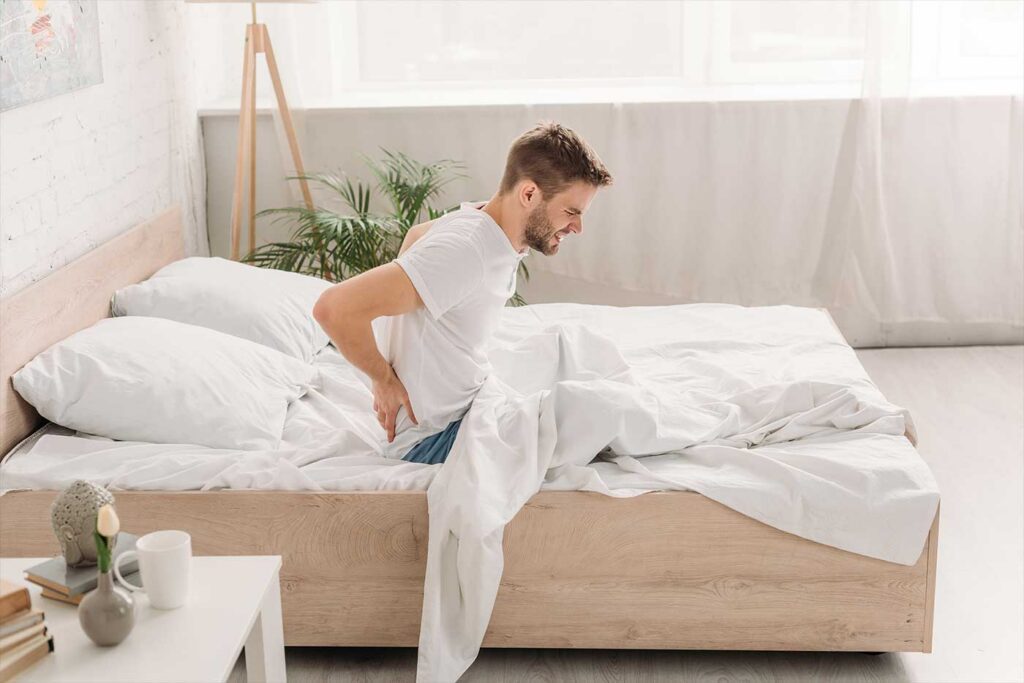
This is the number one reason people can’t get comfortable, and it’s also the most overlooked.
Traditional mattresses — including many older foam and air bed designs — tend to sag in the center over time. That’s exactly where your body weight is most concentrated: your hips and midsection. As the mattress dips, your spine follows, curving unnaturally into what sleep experts call the “hammock effect.” Instead of maintaining its natural S-curve, your spine bends downward at the center, creating tension in the surrounding muscles.
The result? You may not consciously register what’s happening, but your body does. Your muscles work overtime trying to stabilize the spine, which is why you wake up stiff, sore, or exhausted even after a full night in bed. You shift positions repeatedly throughout the night — not because you’re a restless sleeper by nature, but because your body is trying to relieve the discomfort.
The fix: Multi-zone mattress technology addresses this at the root. Airpedic’s patented 6-chamber design creates three independent firmness zones on each side of the bed — one for the head and shoulders, one for the lumbar region, and one for the legs. By allowing the lumbar zone to be set firmer than the others, the mattress actively supports the spine’s natural curve rather than letting it collapse. The result is a sleep surface that keeps your spine straight regardless of your preferred sleep position.
2. The Wrong Firmness for Your Sleep Style
Mattress firmness is not one-size-fits-all. What feels perfectly supportive to one person can cause real discomfort for another — and the difference often comes down to sleep position and body type.
Side sleepers tend to suffer most on mattresses that are too firm. Without enough give at the shoulder and hip, pressure concentrates at those contact points and causes aching that builds throughout the night. Stomach sleepers face the opposite problem: a mattress that’s too soft allows the midsection to sink, arching the lower back into an unnatural position that strains muscles and compresses the spine. Back sleepers sit somewhere in the middle, needing enough softness to cushion the shoulders and enough support to prevent the hips from dropping.
Most static mattresses — foam, innerspring, or hybrid — lock you into one firmness level for the life of the mattress. If your sleep position changes, your weight changes, or your body’s needs shift with age or injury, you’re out of luck.
The fix: Adjustable air beds eliminate this problem entirely. With up to 84 individualized comfort settings, you can dial in your exact level of firmness and change it whenever your body needs something different. There’s no need to layer a mattress topper on top of a mattress that was never quite right — you simply adjust. If your back has been acting up, you firm up the lumbar zone. If you’re recovering from a shoulder injury and switching to side sleeping temporarily, you can soften accordingly.
3. Chronic Pain and Pressure Points
For people managing arthritis, sciatica, joint pain, or fibromyalgia, getting comfortable in bed is more than a minor inconvenience — it’s a nightly challenge that directly affects quality of life.
A flat, static sleep surface applies concentrated pressure to bony prominences: hips, shoulders, knees, and ankles. For a healthy sleeper, that pressure is manageable. For someone with chronic pain, it triggers inflammation and discomfort that compounds over the course of the night. The longer you stay in one position, the more stiffness builds — which is why many chronic pain sufferers wake up feeling worse than when they went to bed.
Over-the-counter solutions like mattress toppers offer a layer of cushioning, but they don’t address the underlying issue of how weight is distributed across the sleep surface. They also don’t account for the fact that chronic pain sufferers often benefit from specific sleep angles that a flat mattress simply can’t provide.
The fix: Pairing a multi-zone adjustable mattress with an adjustable bed base opens the door to Zero Gravity positioning. Originally inspired by NASA research on how astronauts experience weightlessness during launch, the Zero Gravity position elevates both the head and the knees above the level of the heart. This angle distributes body weight more evenly, reduces spinal compression, and takes pressure off joints in a way that lying flat never can. Adjustable bases like the RestFlex series make it easy to find your optimal therapeutic angle — and return to it consistently every night.
4. Sleeping Hot

If you regularly wake up sweating, kicking off covers, or switching to the cool side of the pillow, temperature regulation is disrupting your sleep quality. And for foam mattress owners, the mattress itself is likely a big part of the problem.
Dense memory foam — the material marketed heavily for its pressure-relieving properties — is also notorious for trapping body heat. As your body temperature naturally rises during the early stages of sleep, foam absorbs that heat and holds it. The result is a progressively warmer sleep surface that triggers night sweats and causes your body to move toward lighter, less restorative sleep stages.
Many hot sleepers cycle through mattress types looking for relief — trying gel foam, latex, or hybrid options — without ever fully resolving the issue because they’re treating the symptom (surface temperature) rather than the cause (lack of airflow).
The fix: Airpedic’s Passive Airflow Transfer System™ takes a fundamentally different approach. Rather than using a heat-absorbing material with a cooling gel layer on top, the system uses surface perforations and internal channels throughout the mattress to actively move heat away from the body and circulate cooler air through the structure. It works passively — no electronics, no water systems, no additional hardware — and it addresses the airflow problem at the core of the mattress, not just the surface.
5. Acid Reflux, Snoring, and Breathing Issues
Sometimes the discomfort keeping you up isn’t musculoskeletal at all — it’s internal. Acid reflux (GERD), snoring, and sleep apnea are among the most common sleep disorders affecting adults, and all three are directly worsened by lying flat.
When you’re horizontal, gravity stops working in your favor. Stomach acid can travel freely back up toward the esophagus, causing the burning sensation and sleep disruption that GERD sufferers know well. At the same time, a flat sleeping position can cause the soft tissues of the throat to relax and collapse inward, narrowing the airway. For snorers and those with sleep apnea, this means louder snoring, more frequent apnea events, and sleep that’s fragmented even when it doesn’t feel that way.
Many people try stacking pillows to prop up their head, but this creates an inconsistent, unstable angle that shifts throughout the night. It also puts the neck in a forward flexed position that adds its own discomfort and can actually worsen airway narrowing.
The fix: Clinical guidance for both GERD and sleep apnea often includes elevating the head of the bed by 30 to 45 degrees. An adjustable base makes this simple and precise. Unlike pillow stacking, the elevation is stable, consistent, and reproducible night after night. For people relying on a CPAP for sleep apnea management, the right head elevation can also improve CPAP effectiveness by keeping the airway in a more open position.
6. Partner Disturbance and Motion Transfer

Sharing a bed with someone whose sleep habits differ from yours is one of the most common — and most underestimated — reasons people can’t maintain consistent sleep habits. Even if you fall asleep easily, a partner who comes to bed later, gets up earlier, runs hotter, or simply moves more throughout the night can fragment your sleep in ways you might not even recognize.
Motion transfer is the core mechanical issue. On most mattresses, movement on one side of the bed creates waves that travel across the entire sleep surface. A partner rolling over, shifting positions, or getting up to use the bathroom can register as a minor disturbance dozens of times a night — enough to bump you out of deep sleep without fully waking you.
Then there’s the firmness conflict. One partner may prefer a plush, soft feel while the other needs firm support for back pain. On a traditional mattress, one of you is always compromising — and comfort is a zero-sum game.
The fix: A Split King configuration uses two completely independent Twin XL mattresses placed side by side. Motion stays entirely on the side where it originates — there’s nothing to transfer because the two sleep surfaces are physically separate. More importantly, each partner controls their own firmness settings and elevation independently. One person can sleep flat while the other elevates for acid reflux. One can choose a soft setting while the other dials in firm lumbar support. No compromise, no negotiation, and no 3 a.m. disturbances.
7. You Haven’t Found the Right Sleep System Yet
Sometimes the issue isn’t a single specific problem — it’s the accumulation of several small mismatches between what your body needs and what your current bed provides. A mattress that was adequate five years ago may no longer serve you as your body, sleep habits, and health needs change. And a mattress purchased based on a brief showroom trial or an online quiz may never have been the right fit to begin with.
The concept of a consistent sleep schedule is often discussed in the context of bedtime routines, but the physical environment matters just as much. If your bed is working against you — misaligning your spine, trapping heat, or failing to accommodate your preferred sleep position — no amount of discipline around your wind-down routine will fully compensate.
Better sleep starts with a sleep surface designed to adapt to you, not the other way around.
Making the Switch: Confidence in Your Investment
If you’ve read through this list and recognized yourself in more than one section, that recognition is worth acting on. But buying a new bed is a significant purchase, and it’s reasonable to want reassurance before committing.
Airpedic offers a 120-night sleep trial on their mattresses — giving you enough time to fully adapt to the technology, move through different seasons of sleep needs, and know with certainty whether the system is working for you. That’s not a two-week window designed to expire before the novelty wears off; it’s a real adjustment period that reflects how long it genuinely takes to assess a new sleep system.
Beyond the trial, every Airpedic mattress is backed by a 20-year limited warranty and is made in the USA — a standard of craftsmanship that provides long-term confidence in the investment.
If you’ve been asking yourself “why can’t I get comfortable in bed?” night after night, the answer is almost certainly somewhere in this list. The right mattress won’t just make sleep more comfortable — it will change how you feel during every waking hour that follows.


Experience a new degree of personalized sleep.


Find the Airpedic® that’s just right for your sleep needs.

Buy with monthly payments.
Get an Airpedic Mattress starting as low as $84/mo
or interest-free.
Read More About Healthy Sleep

If you have fibromyalgia, you already know the equation: a bad night in bed turns into a worse day out of it. Pain fragments your sleep, and shallow, broken sleep cranks up your pain sensitivity the next morning. The cycle feeds itself, and the surface you spend a third of…
View More
Call one of our sleep experts to place an order.
Business Hours
- Monday - Friday 8:00am - 6:00pm PST
- Saturday - Sunday 10:00am - 6:00pm PST