



Why One-Size-Fits-All Mattresses Fail: The Science of Zoned Support
The Myth of the Universal Mattress
Walk into almost any mattress showroom and you’ll be asked the same question: “Do you prefer soft, medium, or firm?” The assumption baked into that question — and into most mattresses on the market — is that a single firmness level should work from your shoulders all the way down to your feet. Industry defaults treat bodies as interchangeable, and marketing rarely acknowledges how much anatomical variation matters once you actually lie down.
But the human body doesn’t distribute weight evenly. Your torso, hips, and pelvis carry significantly more load than your head, lower legs, and feet. When a mattress can’t accommodate those differences, the consequences show up quickly: restless nights, morning stiffness, and over time, real spinal misalignment and chronic pain. This article breaks down why uniform mattresses fail, how zoned support solves the problem, and what that means for individual sleepers, couples, and anyone managing joint or back issues.
Why One-Size-Fits-All Mattresses Fail
The “Hammock Effect”
The most common failure mode of a uniform mattress is the hammock effect. The torso — the heaviest part of the body — sinks deeper into the middle of the bed, while the lighter head and feet remain higher. The result is a slight U-shape that pulls support away from the very area that needs it most: your lumbar spine. Innerspring mattresses and basic single-chamber air mattresses are especially prone to this because they have no mechanism to reinforce the middle independently of the ends.
Poor Spinal Alignment
When a mattress is uniformly soft, the hips drop too far below the line of the shoulders and knees. That sag introduces an unnatural curve into the lower spine and forces the surrounding muscles to compensate all night. Over weeks and months, that compensation translates into tight lower-back muscles, neck stiffness, and the kind of fatigue that no amount of caffeine seems to fix.
Pressure Points
A uniformly firm mattress causes the opposite problem. It refuses to cushion bony, prominent areas like the shoulders and hips, which compresses soft tissue and restricts circulation. That’s where the numb arm at 4 a.m. comes from, or the tingling hip that wakes you up needing to roll over. Firm-everywhere doesn’t mean supportive — it means unforgiving in the wrong places.
The Couples’ Compromise
Then there’s the problem nobody likes to talk about: two bodies with very different needs sharing one firmness setting. A 130-pound side sleeper and a 220-pound back sleeper require fundamentally different support profiles, but a uniform mattress forces them to split the difference. Someone always loses — and it’s often the quiet, hidden cause of one partner’s chronic sleep complaints.
The Solution: The Science of Zoned Support
Zoned support — sometimes called multi-zone support — is exactly what it sounds like: the mattress is divided into distinct regions, each calibrated to a different part of the body. Instead of averaging firmness across the entire surface, the engineering principle becomes anatomy-driven. The support beneath your shoulders is tuned for shoulders. The support beneath your lumbar spine is tuned for the heaviest, most alignment-critical region of your body. The support beneath your legs is tuned for the lightest load.
Targeted Adjustability
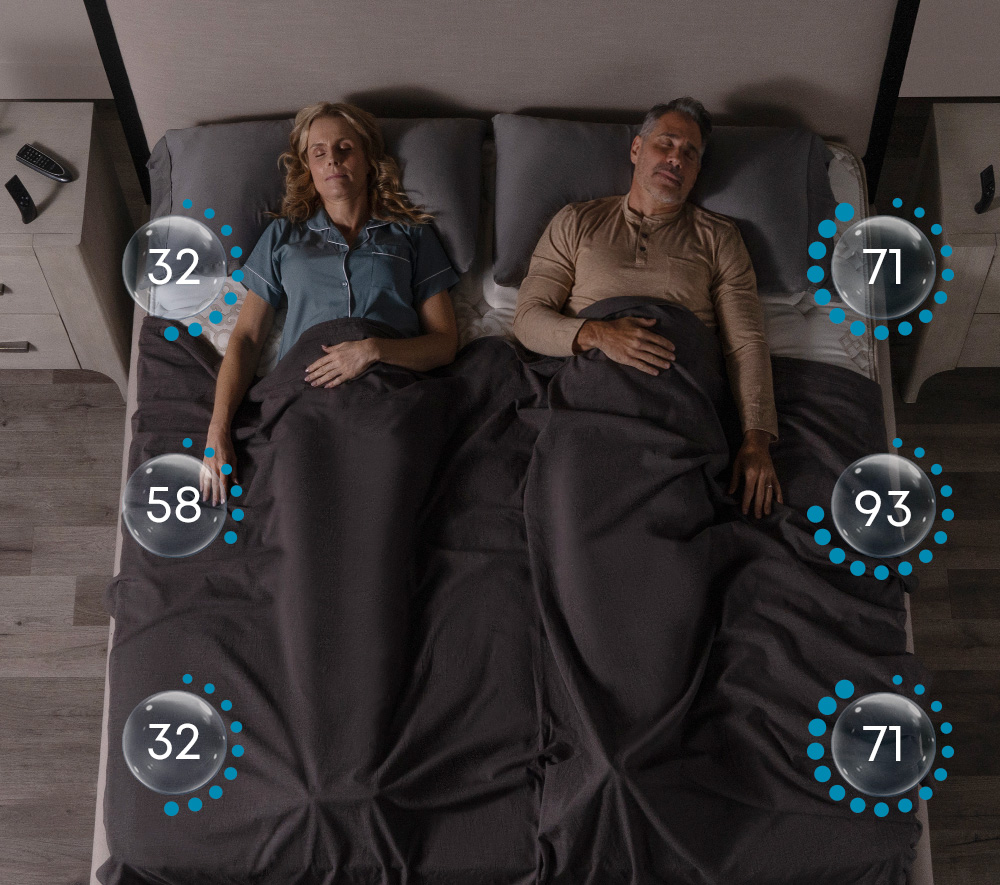
The most refined version of this concept is a Tri-Zone design, which separates the mattress into three independently adjustable zones per side: shoulders, lumbar, and legs. Airpedic’s 6-zone air system is one of the leading examples — three chambers for each sleeper, with head and foot independently adjustable from lumbar. That means a single mattress can carry six different firmness settings simultaneously.
Counteracting Sagging
The most important consequence of independent lumbar adjustment is that it cancels out the hammock effect entirely. When you can increase firmness specifically beneath your lower back, your torso no longer pulls the middle of the bed downward — your spine stays neutral regardless of body weight. That single capability is the difference between a mattress that fights your anatomy and one that works with it.
Customization for Every Sleep Position
Because each zone moves independently, a single zoned mattress can biomechanically serve any sleep style.
Side Sleepers
Side sleeping concentrates body weight onto two narrow contact points: the shoulder and the hip. Without zoning, those points either compress painfully or push the spine into a twist. With zoned support, side sleepers can soften the shoulder and leg zones for gentle pressure relief while keeping the lumbar zone firmer to prevent the waist from collapsing inward. The result is a spine that stays parallel to the mattress surface, the way it should.
Back Sleepers
Back sleepers are trying to preserve the spine’s natural S-curve — not flatten it, not exaggerate it. The lumbar zone needs medium-firm reinforcement to support that curve without letting the lower back sink, while the shoulder and leg zones stay balanced enough to keep the body in a continuous, level line.
Stomach Sleepers
Stomach sleeping is the position most likely to cause lower-back strain, because the hips naturally sink and pull the pelvis out of alignment. A firmer lumbar setting solves this directly by keeping the pelvis level with the shoulders. The rest of the body stays on a neutral plane instead of bowing downward at the midsection.
If you imagine a side-by-side diagram of spinal alignment across the three positions, the contrast between zoned and uniform support becomes obvious: zoned mattresses preserve a straight line through the spine in every configuration; uniform mattresses don’t.
Dual-Sided Independence for Couples
Zoned support also resolves the couples’ compromise. With dual-sided adjustability, each partner controls their own set of zones — no negotiation, no splitting the difference.
In practice that might look like this: Partner A programs a plush, pressure-relieving feel because they sleep on their side and have shoulder sensitivity. Partner B sets a firm lumbar zone because they have lower-back pain and sleep on their back. Both get exactly what their body needs from the same bed, on the same night.
Independent air chambers add a second benefit: motion isolation. When one partner shifts, sits up, or climbs out of bed, that movement is absorbed locally rather than transmitted across the entire surface. The restlessness on one side doesn’t ripple across to the other.
This is what real personalization looks like — sleep technology built around two distinct bodies rather than an averaged compromise.
Orthopedic Health and Pain Relief
For anyone managing chronic pain, joint conditions, or post-surgical recovery, zoned support isn’t a luxury feature — it’s a clinical one. By distributing weight evenly across the body, zoned mattresses reduce the localized pressure that triggers joint inflammation and morning stiffness. Chiropractors and physical therapists routinely emphasize that recovery happens during sleep, and a surface that fights the body undermines that process every night.
The condition-specific applications are concrete:
- Arthritis: zones can be softened directly under the joints that flare most often.
- Chronic back pain: independent lumbar control allows precise reinforcement of the exact level that hurts.
- Hip pain and post-surgical recovery: firmer lower-zone settings keep the pelvis stable and reduce side-lying pressure.
- Sciatica: targeted lumbar adjustment relieves the compressive load that often aggravates the nerve.
The zone-by-zone logic is intuitive once you start thinking about it that way. Soften the upper zone for shoulder arthritis. Firm the lower zone for hip support. Adjust as your condition changes.
The bigger framing is this: restorative sleep is mechanical, not just behavioral. You can have perfect sleep hygiene, a dark room, and a consistent schedule, but if the surface beneath you is misaligning your spine for eight hours a night, recovery stalls. A properly zoned orthopedic mattress addresses the mechanical half of that equation directly.
Conclusion: Sleep Built for Your Body, Not the Average Body
Uniform firmness ignores anatomy. Zoned support respects it. That single shift in design philosophy delivers the three benefits that matter most: proper spinal alignment, real pressure relief at the points that need it, and partner-independent customization that ends the firmness compromise once and for all.
The right mattress isn’t the firmest or the softest. It’s the one that adapts to you.


Experience a new degree of personalized sleep.


Find the Airpedic® that’s just right for your sleep needs.

Buy with monthly payments.
Get an Airpedic Mattress starting as low as $84/mo
or interest-free.
Read More About Healthy Sleep

You’ve been lying there for 30 minutes. You flip to your left side. Then your right. You readjust your pillow, kick one leg out from under the covers, and stare at the ceiling. Sound familiar? If you find yourself endlessly hunting for “the right spot” every night, you’re not alone…
Why Do My Ribs Hurt When I Wake Up? Waking up to a deep, nagging ache along your rib cage is unsettling. For a moment, your mind jumps to the worst-case scenarios — your heart, your lungs, something serious. But take a breath. In the overwhelming majority of cases, morning…
View More
Call one of our sleep experts to place an order.
Business Hours
- Monday - Friday 8:00am - 6:00pm PST
- Saturday - Sunday 10:00am - 6:00pm PST